How Tall Is The Statue Of Liberty In Centimeters . There is a minimum height requirement of 48 in (122 cm). The statue of liberty is 305 feet tall and was built using 31 tons of copper and 125 tons of steel. Unfinished Wooden Statue of Liberty New York City from www.walmart.com With the pedestal and foundation included in the measurement, the full height is 305 ft. How tall is the statue of liberty in centimeters? The statue of liberty is approximately 150 feet tall from the base to;
How To Find Initial Height In Quadratic Equations. Use the quadratic function h(t) = −16t 2 + 109t + 0 to find how long it will take for the ball to reach its maximum height, and then find the maximum height. Divide both sides of the equation by “a”.
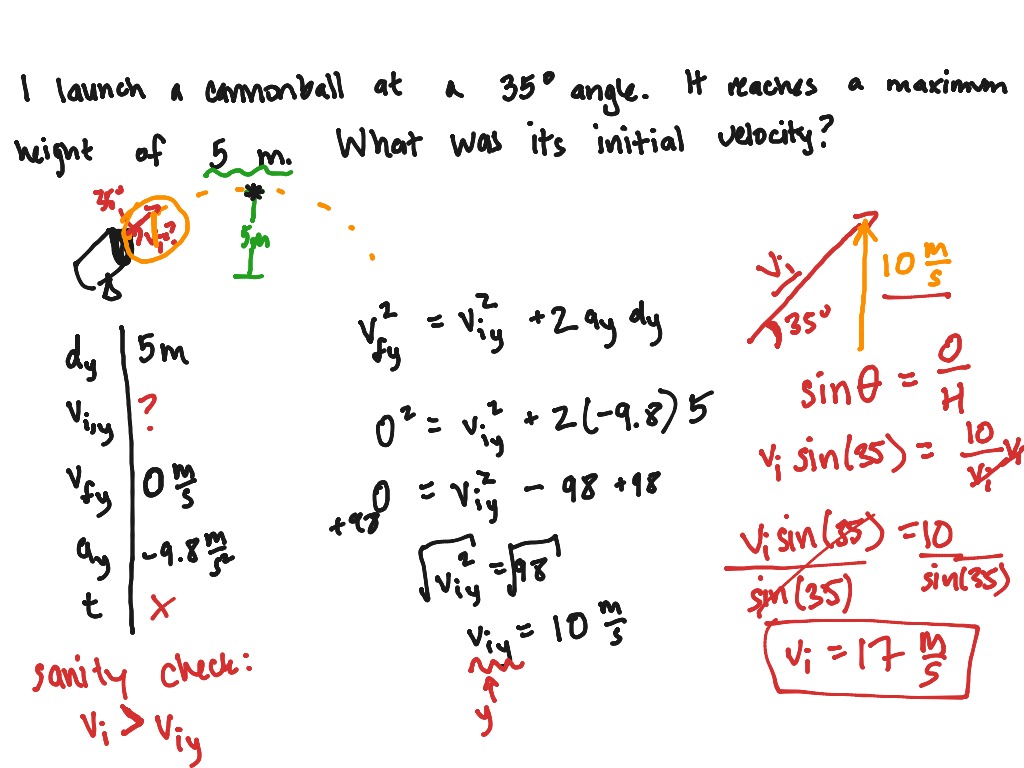
Using Height to Find Initial Velocity Science from www.showme.com
Solving projectile problems with quadratic equations. Write an equation to find how long it takes the tile to hit the ground. The ball's height h (in meters) at time t (in seconds) can be modeled by the quadratic function h(t) = —4.9t2 + 14t + 2.
If \(Ax^2+Bx+C=0\) Is A Quadratic Equation Where A Is The Coefficient Of \(X^2\), B Is The Coefficient Of X And C Is The Constant Term.
Steps to solve a quadratic equation by completing the square, follow these steps:example: When will it attain this height? The initial height is 80 feet above ground and the initial speed is 64 ft/s.
I Personally Like To Keep The Final Height At Zero For All Calculations , Since Initial Height Is The Variable Provided In Our Equations That Requires The Least Rearranging.
An arrow is shot vertically upward from a platform 45 feet high at a rate of 168 ft/sec. the equation of the quadratic will be given. For a ball that lands 3 feet lower , initial height is positive , where if the ball landed at a higher point ,.
—4.9T2 + 14T+ 2 = 12 —4.9T2 10—0
Set h(t) equal to 12. S=initial height (feet) v=initial velocity (feet per sec) notice that the function is quadratic, which when graphed will be parabolic. The flight of a rocket
Algebraic Method Of Solving Quadratic Equations.
A ball is thrown in the air with an initial vertical velocity of 14 m/s from an initial height of 2 m. Suppose a rock is dropped from the same initial height on the three planets shown. T = −b/2a = −(−14)/(2 × 5) = 14/10 = 1.4 seconds;
Write An Equation To Find How Long It Takes The Tile To Hit The Ground.
Write the equation in the form ax2+ bx ____ = c *leave room to add a third term to this side. So, we just need to find the initial velocity, the initial height, and whether we are dealing in meters or feet. Substitute 2.8125 for t in the original equation to find the height:


Comments
Post a Comment